 Control Tower
 Agents calling agents
Agents increasingly work through other agents: a support bot asks a research agent, a planner hands work to a coder. Control Tower follows these calls from one agent to the next, draws who acts for whom, and lets you put gates on whom a call is made for — so a low-privilege, public-facing agent can't get a high-privilege agent to do what it may not do itself.
Quick reference
| An agent behind a tool | Register its MCP server or HTTP API with Fronts an agent set to that agent's ID |
| An agent that speaks A2A | Register it under A2A agents: it is an agent by definition |
| The delegation token | Sent to that agent with each call: _meta["controltower/delegation"] (MCP), params.metadata["controltower/delegation"] (A2A) and the x-ct-delegation header |
| What the called agent does | Sends the same token back as x-ct-delegation on its own calls to Control Tower |
| Keys that only act for others | Acts only on behalf of other agents on the key: calls without a valid token are refused |
| Gates on whom a call is for | match.on_behalf_of: [agent:<agent id>, team:<name>] — anywhere up the chain |
| Where it shows | Flights (for support-bot), a purple arc between the two agents on the Airspace, the trace panel (called by) |
An agent behind a tool
Most agent-to-agent calls today are one agent calling another through a tool: the second agent is an MCP server (or an HTTP API) whose tools do their own work — and make their own model and tool calls.
Step 1: Give the called agent a key that only acts for others
Create a key for the agent being called — here research-agent — and tick Acts only on behalf of other agents. Every call it makes must then carry the delegation token it was called with, so a gate on whom a call is for can't be escaped by leaving the token off. In the API this is "delegated_only": true on POST /admin/api/keys or PATCH /admin/api/keys/:id.
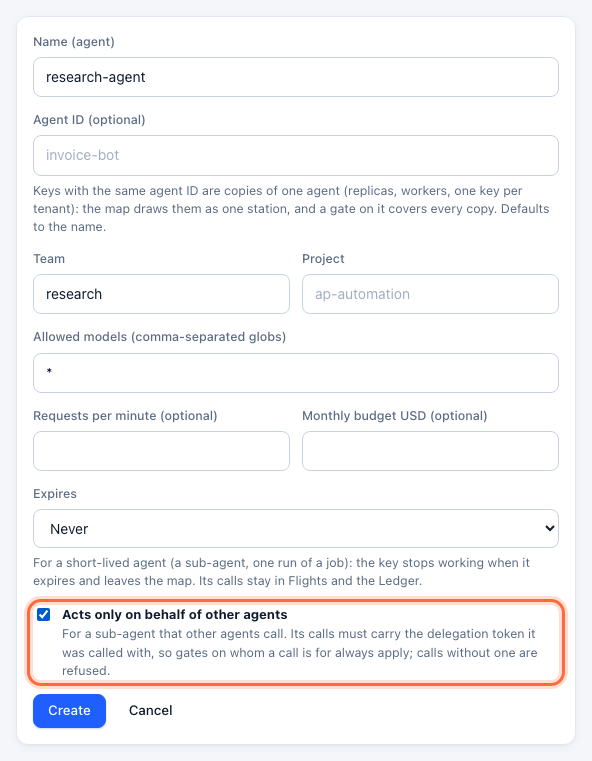
Step 2: Register its server as fronting that agent
Under MCP servers → Add server (or HTTP APIs), register the agent's endpoint and set Fronts an agent to its agent ID:
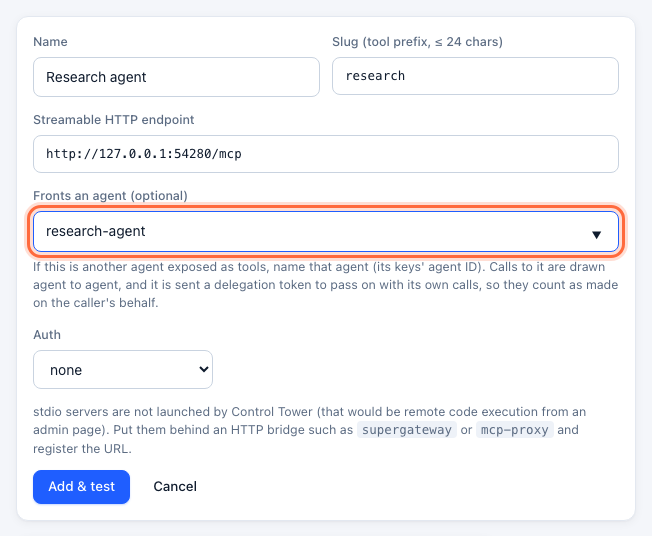
Calls to it now go agent to agent: each carries a delegation token saying which agent called — and, further up, on whose behalf. The API equivalent is agent_id on POST /admin/api/mcp/servers or /admin/api/http/apis.
Step 3: Pass the token on
The called agent reads the token from the call it received and sends it back with its own calls to Control Tower, as the x-ct-delegation header. An MCP server built with the official TypeScript SDK:
server.registerTool('ask', { inputSchema: { question: z.string() } }, async ({ question }, extra) => {
  // Control Tower puts the token in the call's _meta, and in the x-ct-delegation header.
  const token = (extra._meta?.['controltower/delegation'] as string | undefined) ?? (extra.requestInfo?.headers['x-ct-delegation'] as string | undefined);
  const openai = new OpenAI({ baseURL: 'http://localhost:4000/v1', apiKey: process.env.RESEARCH_AGENT_KEY, defaultHeaders: token ? { 'x-ct-delegation': token } : {} });
  const r = await openai.chat.completions.create({ model: 'gpt-4.1-mini', messages: [{ role: 'user', content: question }] });
  return { content: [{ type: 'text', text: r.choices[0]!.message.content ?? '' }] };
});
An agent behind an HTTP API, in Python:
@app.post("/ask")
def ask(req: Request, body: Question):
    token = req.headers.get("x-ct-delegation")
    client = OpenAI(base_url="http://localhost:4000/v1", api_key=RESEARCH_AGENT_KEY,
                    default_headers={"x-ct-delegation": token} if token else None)
    ...
Pass it on every call the agent makes while handling that request — model calls, MCP tool calls (as a header, or _meta["controltower/delegation"]) and HTTP API calls. When the agent in turn calls a third agent through Control Tower, that one gets a new token for the longer chain.
Step 4: See it
The called agent's calls are in Flights with whom they were made for:
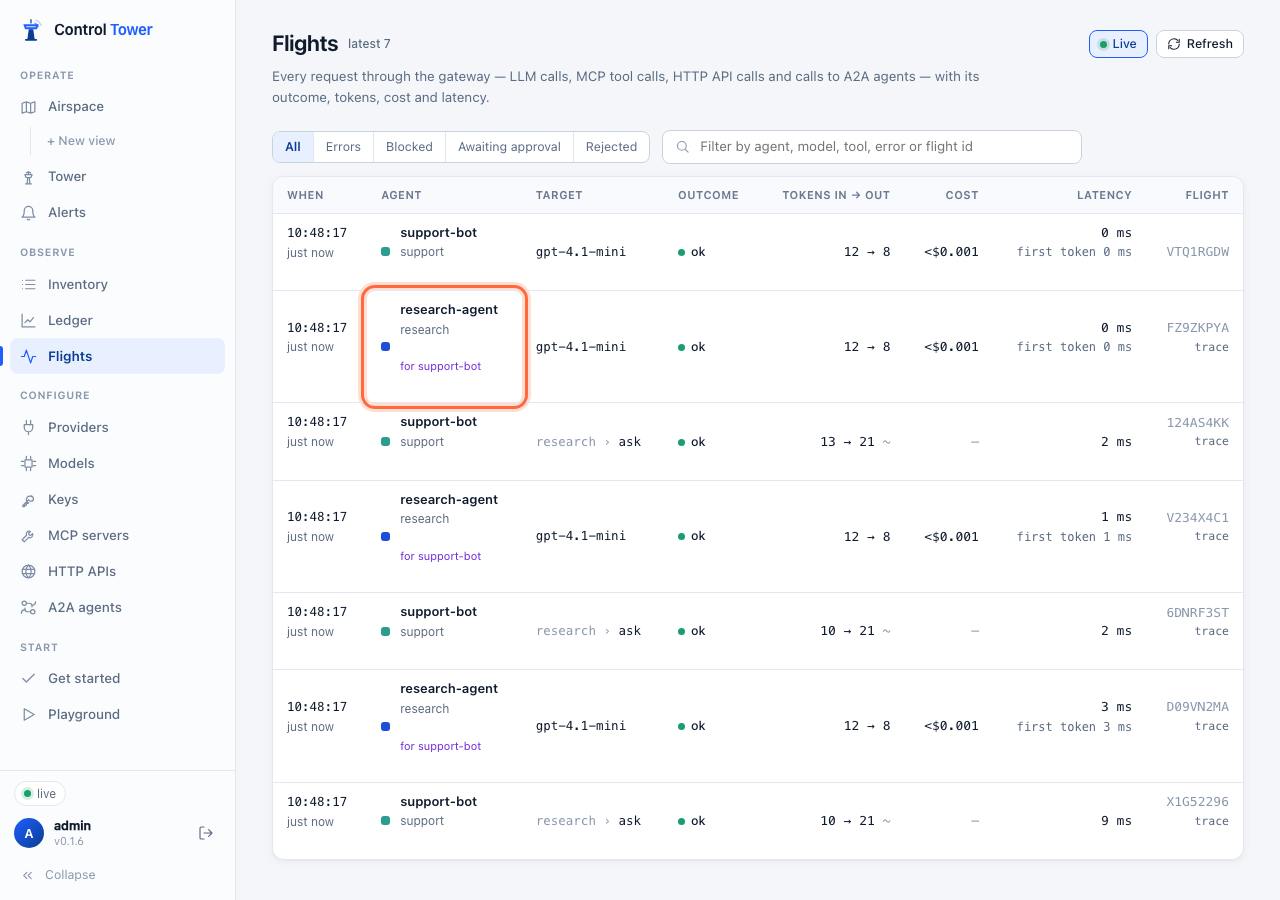
- Click an agent in the purple for … chain to show only the calls made for it, anywhere up the chain.
- A call that is part of a chain has a trace link: it shows the whole chain — the call that started it and every call it led to — indented in call order.
- A call refused with
delegation_required,delegation_loopordelegation_too_deepis recorded as rejected, with the chain it carried.
In the API: GET /admin/api/flights?for=<agent id> and GET /admin/api/flights?trace=<flight id>; each flight has parent_flight_id (the call that led to it) and has_children. See API reference.
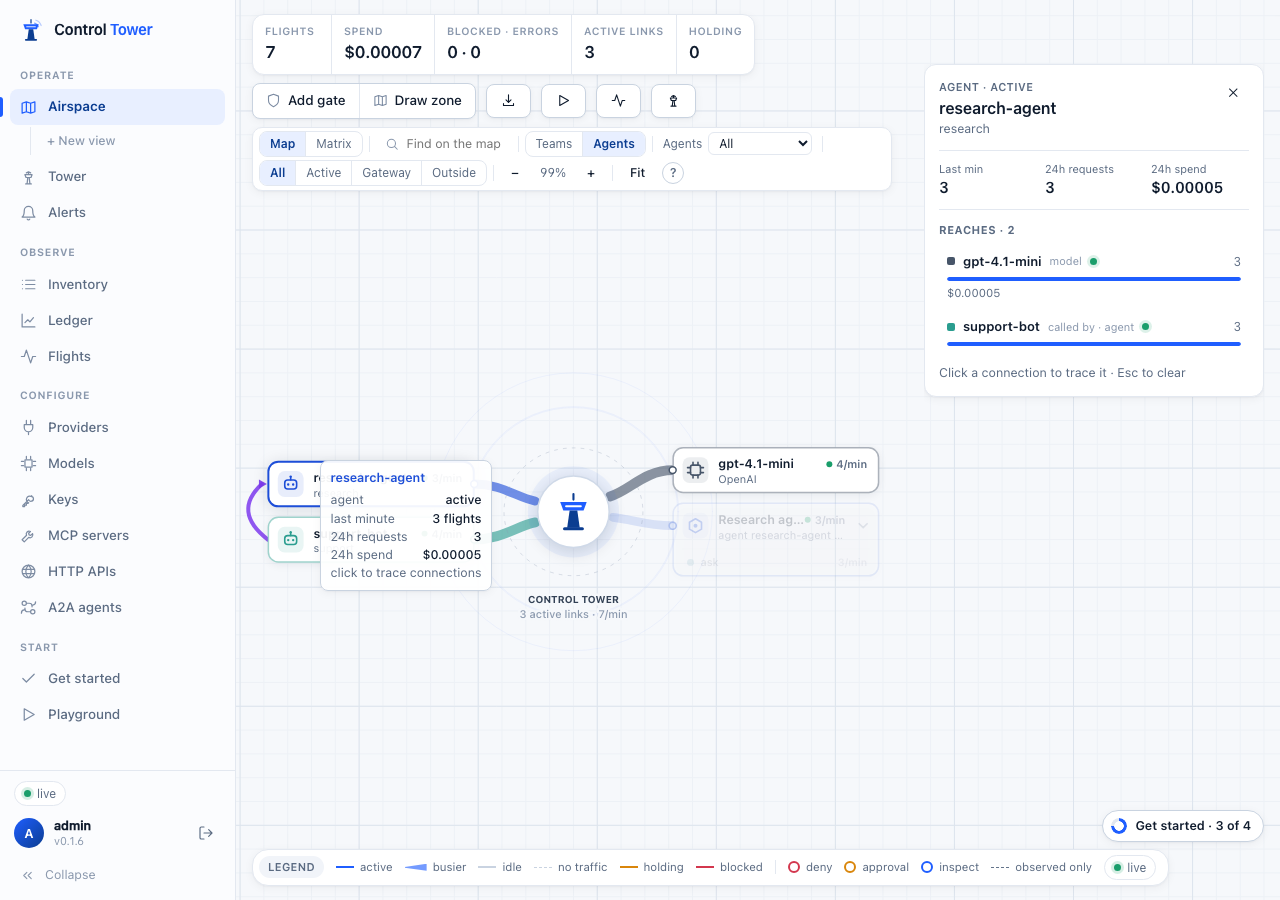
On the Airspace a purple arc beside the agents runs from the calling agent to the called one — thicker with more calls, bright while live. The calls themselves still go through the tower (to the agent's server on the right); the arc says who is acting for whom. Click the arc for the calls behind it: the latest calls (up to 50, over the last week) from one agent to the other's server, what each led to, and how many calls the called agent made on the caller's behalf, each with a trace link into Flights (GET /admin/api/airspace/agent-link).
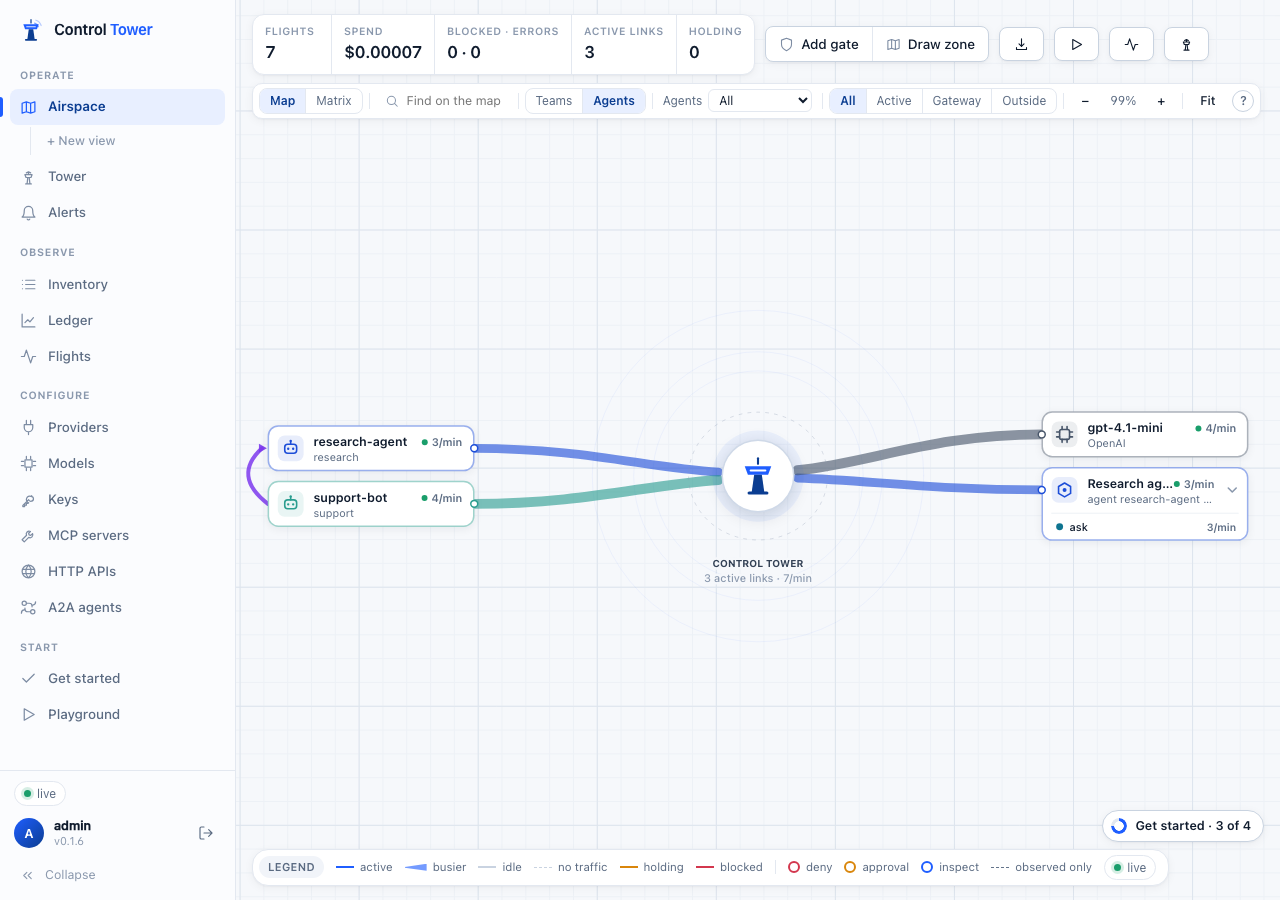
Tracing either agent lists the other as calls or called by:
An agent over A2A
Agents that speak the A2A protocol are registered under A2A agents by their Agent Card. Set its Agent ID to the agent ID on its own Control Tower key. Each call gets a delegation token in the request's params.metadata["controltower/delegation"] and the x-ct-delegation header; the agent passes it on exactly as in step 3, and everything above — the arc on the map, for … in Flights, gates on whom a call is for — works the same.
// In an agent built with the official JavaScript SDK (@a2a-js/sdk): the token arrives with the request.
const executor: AgentExecutor = {
  async execute(ctx, bus) {
    const token = ctx.request.metadata?.['controltower/delegation'] as string | undefined;
    // …pass it on as the x-ct-delegation header on this agent's own calls to Control Tower
  },
  async cancelTask() {},
};Spend and budgets
What an agent spends while acting for another counts against both: its own key's budgets (key, team and project) and those of the agent that started the chain. If research-agent spends $2 answering support-bot, support-bot's budget — and the support team's — go down by $2 too, and support-bot's hard budget, once spent, stops the research agent's work for it (429 budget_exceeded).
- The data-flow inventory shows, for each path, the agents its calls were made for, and for each agent what others spent on its behalf (spent for it).
- Metrics:
controltower_delegated_requests_totalandcontroltower_delegated_spend_usd_total, byorigin(the agent that started the chain) andagent.
Gates on whom a call is for
A gate can match calls made on behalf of an agent or a team, however many agents deep. In the gate editor, choose Only when acting for; in a policy file, match.on_behalf_of:
gates:
  # Nothing done for the public-facing agents may touch finance tools — even through another agent.
  - name: No finance on behalf of support
    match:
      on_behalf_of: [team:support]
      servers: [ledger]
    effect: deny

  # A person approves before any agent spends money for the SDR bot.
  - name: Payments for the SDR bot need approval
    match:
      on_behalf_of: [agent:outbound-sdr]
      tools: ["payments__*"]
    effect: require_approval
Gates on the caller itself keep working as usual: support-bot may not call research-agent is a gate from support-bot to the research agent's server.
When a gate holds a call made on someone's behalf, its approval card says whom it is for — For orchestrator-agent → planner-agent — and so do held alerts by email, Slack or webhook. The same call made for two different agents is two cards: approving one never approves the other.
How the token works
- It is signed with a key derived from Control Tower's master key and never stored, so it can't be forged or edited.
- It is issued to one agent: presented by any other agent it is ignored, and the flight carries a flagged event delegation token ignored:
(a key that only acts for others is refused instead). An expired token is treated the same way. - A call to an agent already earlier in the chain — A calls B, and B calls A back — is refused (
delegation_loop): agents answer the agent that called them rather than calling it again. - An agent may hand work to itself once — calling its own server is not a loop — but not again from there: A → A is allowed, A → A → A is refused (
delegation_loop), so recursion can't run away. - It expires after 15 minutes; a chain may be at most 8 agents deep (
delegation_too_deep). - It never appears in logs, events or Flights — only the chain of agent IDs does.
Long tasks: renew the token
A task that runs longer than 15 minutes — a long A2A task or stream — renews its token before it expires. The agent it was issued to sends it, with its own key, and gets a fresh one for the same chain:
curl -s $CT/v1/delegation/renew -H "Authorization: Bearer $RESEARCH_AGENT_KEY" \
  -H "x-ct-delegation: $TOKEN"
# {"token": "ctd1.…", "expires_at": 1790360000000}
Renew whenever less than a few minutes are left, and use the new token from then on. Only a token that is still valid can be renewed, and only by the agent it was issued to; a delegation can be kept alive this way for up to 24 hours from its first token (delegation_invalid after that).
Agents inside one app
When sub-agents run inside one process — LangGraph nodes, CrewAI crews, handoffs in the OpenAI Agents SDK — there is no network hop between them for Control Tower to see. Give each sub-agent its own key so each is its own station with its own gates and budget; when one of them calls another through a tool served by Control Tower, the rules above apply.
Troubleshooting
| Error | Cause | Fix |
|---|---|---|
403 delegation_required | A key that only acts for others made a call without a valid token | Pass on the x-ct-delegation header of the call it received; check it didn't expire (15 min) |
…issued to another agent | The token was passed to a different agent than the one called | Each agent passes on only the token it received; the server must front the right agent ID |
403 delegation_loop | The call goes to an agent already earlier in the chain | Return the answer to the calling agent instead of calling it back |
403 delegation_too_deep | More than 8 agents in the chain | Shorten the chain |
| No arc on the map | The server isn't marked as fronting an agent, and no call carried a token | Set Fronts an agent, and pass the token on (step 3) |
Next steps
- Airspace, gates & approvals
- Policy as code —
on_behalf_ofin files - A2A agents
- MCP gateway