 Control Tower
 Key rotation
Two kinds of keys rotate:
- Agents' keys (
ct_sk_…) get a new secret while the old one keeps working for an overlap, now or on a schedule. On a schedule, the new secret is written into your secret manager for the agent to read. Enterprise. - The master key, which encrypts every credential Control Tower stores, can be replaced with one command. In every edition.
Provider keys (OpenAI, Anthropic, …) rotate at the provider. Keep them in a secret manager and Control Tower picks up the new one on its own.
An agent's key
Enterprise: needs a Control Tower Enterprise license.
Now, with an overlap
On Keys, open rotation… under a key.
Rotate now gives the key a new secret, shown once. Choose how long the old secret keeps working: it can stop at once, or keep working for 10 minutes, an hour, a day or 7 days. Agents switch to the new secret during that time without a failed call.
The key keeps its name, permissions, limits, budget, gates and history; only its secret changes.
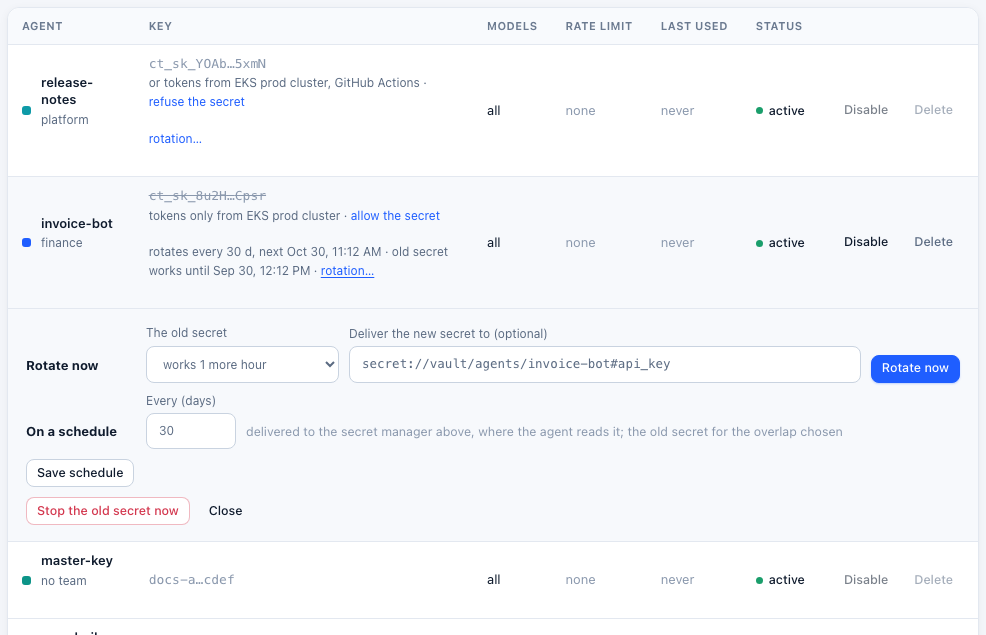
Stop the old secret now ends the overlap early, for a key you believe has leaked.
On a schedule, delivered to your secret manager
Set Every (days) and Deliver the new secret to, a secret reference such as secret://vault/agents/invoice-bot#api_key, then Save schedule. When the key is due, Control Tower:
- makes a new secret;
- writes it to the secret manager first. If the manager refuses, nothing changes: the key keeps its secret, the error shows on the key and in the audit log, and it's tried again every 5 minutes;
- saves it, keeping the old secret for the overlap;
- records the rotation in the audit log (by Control Tower,
keys.rotate).
The agent reads its key from the secret manager, the way it reads any other secret. Nobody handles the secret, and none lives longer than the schedule. For example:
- a Vault Agent or the External Secrets Operator syncs the secret into the pod as a file or environment variable;
- the AWS, Google or Azure SDK reads it at start, then re-reads it when a call is refused.
Keep the overlap longer than the time it takes your agents to pick up the new secret.
With several instances, only one rotates a given key. It holds a claim on the key while it rotates, and the claim lapses after a minute if that instance stops.
Rotate now also delivers to the key's secret reference when it has one. The new secret is then written there and not shown.
Or no secret at all
Agents that can present a token from your identity provider need no key secret to rotate: see Agent identity.
The master key
The master key encrypts every credential Control Tower stores: provider keys, tool server tokens, export and alert settings, and secret managers' own credentials. To replace it:
Stop every instance. The command refuses while an instance is still running on the database (add
--forceif one crashed and can't be stopped).Run the command with the same data directory or database as the server:
# The master key is in the data directory (the default): a new one is generated there.
docker run --rm -v ct-data:/data ghcr.io/joshmaster2165/controltower --rotate-master-key

# The master key comes from CT_MASTER_KEY: give the new one too.
docker run --rm -e CT_DATABASE_URL -e CT_MASTER_KEY -e CT_NEW_MASTER_KEY="$(openssl rand -base64 32)" \
  ghcr.io/joshmaster2165/controltower --rotate-master-key
Every stored credential is decrypted with the old key and encrypted with the new one, in one transaction: it all changes, or nothing does.
Start the instances with the new key.
- In the data directory:
master.keynow holds the new key, andmaster.key.previousthe old one. Back up the new one, then delete the old. - From the environment: set
CT_MASTER_KEYto the new value on every instance. With Helm, updatesecrets.masterKey(or theCT_MASTER_KEYin yoursecrets.existingSecret).
- In the data directory:
An instance started with the old key refuses to start, saying the database uses another key.
What doesn't carry over: anything sealed with the old key but not stored is invalidated. That means delegation tokens already issued to agents (they ask for new ones), and single sign-on attempts in progress (people sign in again). Agents' keys, sessions and passwords are stored as hashes, not encrypted, so they are unaffected.
API
Admins only; Enterprise.
| Method | Path | |
|---|---|---|
| POST | /admin/api/keys/:id/rotate | {overlap_s, deliver_to}, both optional. overlap_s defaults to the key's own or 3600, from 0 to 604800. deliver_to defaults to the key's own; null means don't deliver. Answers {key} (or {delivered_to}), prefix, last4, old_valid_until |
| PUT | /admin/api/keys/:id/rotation | {every_days: 1–365 | null, overlap_s, deliver_to}. A schedule needs deliver_to |
| POST | /admin/api/keys/:id/rotate/end-overlap | Stop the old secret now |
GET /admin/api/keys lists rotation (every_days, overlap_s, deliver_to, last_rotated_at, next_at, error) and old_secret_valid_until for each key.