 Control Tower
 Exporting flights
Exports sends every call, as it completes, to your own tools: OpenTelemetry tracing, Datadog, Splunk, an S3 bucket, or any webhook. It sends what the call was, not what it said. Each record has:
- who made the call (key, agent, team, project, and the agents it acted for);
- where it went (model, provider, tool);
- what the gates decided, and any approval;
- tokens, cost, timings, errors, tags and the customer;
- who presented the token, when the agent used one from your identity provider (
principal).
Control Tower never records prompts or answers, so no destination ever receives one.
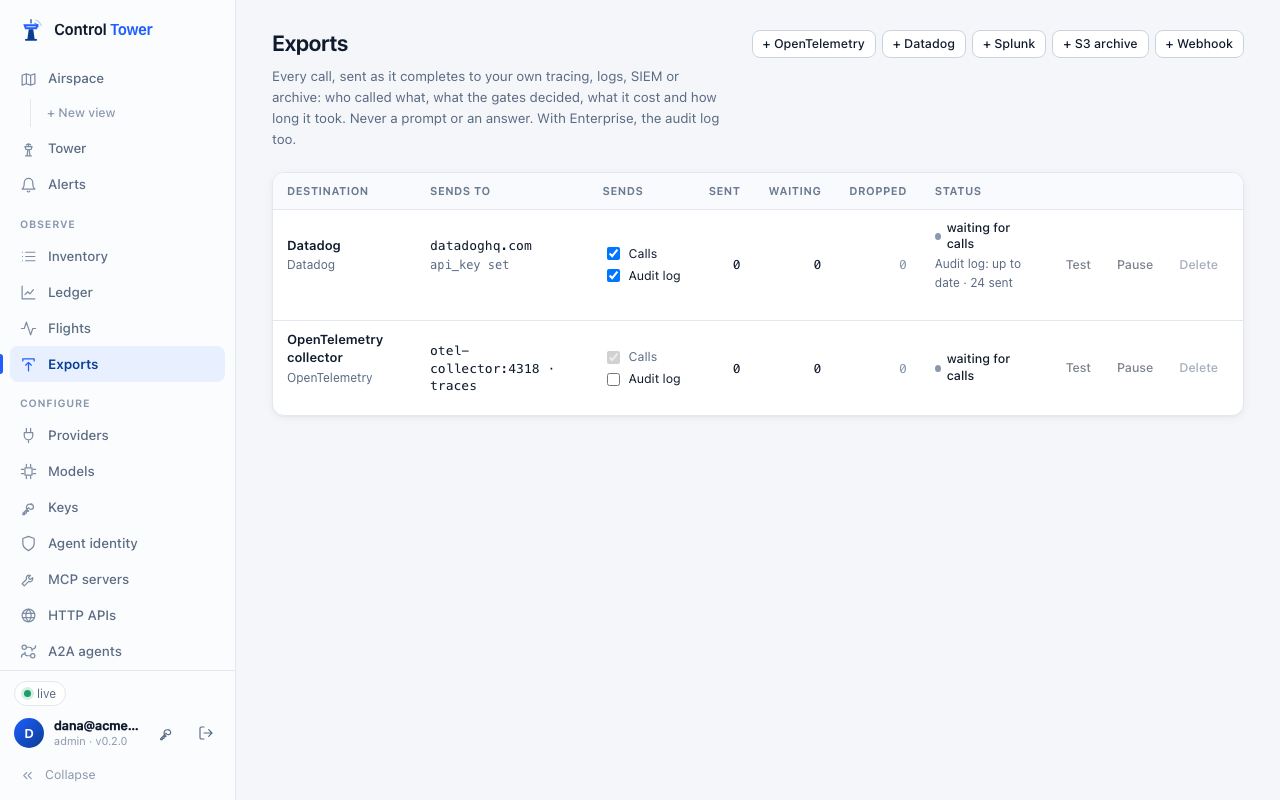
What to send
Each destination receives calls (the records on this page), the audit log, or both. The audit log is every change made in Control Tower and every refused attempt, sent in order and without gaps, for your SIEM. It needs Enterprise: see Audit log to your SIEM.
Destinations
| Destination | What it receives | Settings |
|---|---|---|
| OpenTelemetry | OTLP/HTTP JSON sent to <endpoint>/v1/traces as spans, or to /v1/logs as log records. Attributes follow the GenAI semantic conventions (gen_ai.operation.name, gen_ai.request.model, gen_ai.usage.input_tokens, …), and anything else is under controltower.* | Endpoint (e.g. http://otel-collector:4318), traces or logs, and an optional Authorization header |
| Datadog | Log intake v2, one log per call. status is the log level, and the call's own status is flight_status | API key, site (datadoghq.com, datadoghq.eu, us5.datadoghq.com, …), service, tags |
| Splunk | HTTP Event Collector events, source type controltower:flight | HEC URL, token, index, source type |
| S3 archive | Gzipped JSON Lines files at <prefix>YYYY/MM/DD/HH/<time>-<id>.jsonl.gz, SigV4-signed | Bucket, region, prefix, access key. For S3-compatible stores (Cloudflare R2, MinIO, …), set their endpoint |
| Webhook | {"type": "controltower.flights", "records": [...]}, signed with x-ct-signature: t=…,v1=… like alert webhooks | URL and an optional signing secret |
Send a test record delivers an example record before you save. Test sends one to a saved destination. API keys, tokens, secret keys and header values are stored encrypted, and are never shown again.
Spans in your agents' traces
An agent instrumented with OpenTelemetry sends a W3C traceparent header with its requests. Control Tower's span for that call then joins the agent's trace as a child of the span that made the call, so the model or tool call, the gate that held it and its cost all appear where your traces already are. Calls without a traceparent get a trace of their own.
A record
{
  "type": "controltower.flight",
  "id": "01K5…",
  "started_at": "2026-09-28T17:14:03.120Z",
  "duration_ms": 842,
  "status": "ok",
  "kind": "chat",
  "agent": { "key_name": "support-bot", "agent_id": "support-bot", "team": "support" },
  "customer": "acme",
  "tags": ["ticket-triage"],
  "target": { "model_requested": "smart", "provider_kind": "openai", "upstream_model": "gpt-4.1" },
  "decision": { "effect": "allow" },
  "usage": { "input": 812, "output": 96, "cache_read": 0, "cache_write": 0, "source": "provider" },
  "cost_usd": 0.002392,
  "latency": { "ttfb_ms": 610, "ttft_ms": 612, "gateway_overhead_ms": 1 },
  "trace": { "trace_id": "4bf92f35…", "parent_span_id": "00f067aa…" }
}
A blocked call carries the gate's decision (deny, with its rule_id and reason). A held call carries its approval (approved, denied, expired or ticketed, and who decided). Inspect gates that flagged or masked something appear under findings, as detector and action, never the content.
Delivery
- Batching: records go out in batches of up to 500, every two seconds.
- Retries: a batch that fails is retried twice (after 2 s, then 10 s), then dropped and counted.
- Queue limit: a destination that is down keeps up to 20,000 records waiting, dropping the oldest after that.
- Status: Exports shows, for each destination, what was sent, what is waiting, what was dropped, and the last error.
- Pausing and stopping: Pause stops sending to a destination; nothing is kept for it while paused. On shutdown, what is waiting is sent within a few seconds.
- Several instances: with several instances, each sends the calls it served.
The audit log is delivered differently: from the log itself, so nothing waits in memory, nothing is dropped while a SIEM is down, and a restart loses nothing. See delivery of the audit log.
API
Admins only.
| Method | Path | |
|---|---|---|
| GET | /admin/api/exports | Destinations, with their settings (secrets only as secrets_set), what they send, and delivery state |
| POST | /admin/api/exports | {name, kind, config, send_flights, send_audit, audit_from}. send_flights is true unless set; send_audit and audit_from are for the audit log |
| PATCH | /admin/api/exports/:id | Any of name, enabled, config (secrets left out keep their stored values), send_flights, send_audit |
| DELETE | /admin/api/exports/:id | |
| POST | /admin/api/exports/test | {id} for a saved destination, or {kind, config} for settings not saved yet; "stream": "audit" sends an example audit event instead of a call. Answers {ok} or {ok: false, error} |
| POST | /admin/api/exports/:id/flush | Send what is waiting now |
What config holds for each kind:
kind | config |
|---|---|
otlp | endpoint (required, e.g. http://otel-collector:4318), signal (traces or logs, default traces), headers |
datadog | api_key (required), site (datadoghq.com), service (controltower), ddtags, endpoint (to send through a proxy) |
splunk | url (required: the HEC base URL), token (required), index, sourcetype (controltower:flight), audit_index (for the audit log; default index) |
s3 | bucket, access_key_id, secret_access_key (required), region (us-east-1), prefix (controltower/), session_token, endpoint (S3-compatible stores) |
webhook | url (required), secret, headers |
api_key, token, secret_access_key, session_token, secret and headers are secrets: stored encrypted and never returned.